Automotive Industry
As the automotive industry continues to evolve towards sustainability, mild hybrid electric vehicle (MHEV) strikes a balance between environmental responsibility and financial practicality. MHEVs improve fuel efficiency and reduce emissions while maintaining a familiar driving experience which makes them an attractive choice for car owners. Major automakers have introduced MHEVs to meet stricter emission standards. By combining the power of internal combustion engine (ICE) and electric motor, MHEVs provide a practical transition towards full electrification.
As more and more electrical and electronic components are added to cars, 12 V systems are stretching to their limit. The industry has responded by developing improved electrical systems with a 48 V battery. Many automakers have been launching new models of 48 V MHEVs or upgrading their existing models with 48 V systems.
With the market trending toward 48 V systems, that means the traditional lead-acid battery will be replaced with the new lithium-ion battery. The new batteries are expected to withstand the vehicle's life span and improve the performance of the electrical systems. On top of this improvement to low voltage architecture, it brings additional benefits of reduced size and weight of the systems.
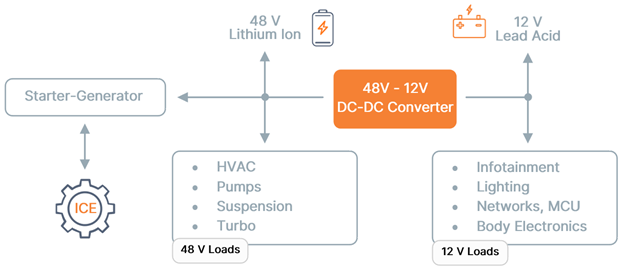
48 V system provides a significant boost in power over 12 V. While a standard 12 V system can put out a maximum of 2 to 4 kW, the 48 V system can deliver up to 10 − 20 kW. The higher voltage does a better job at operating heavy−duty devices like pumps, compressors, turbos, and suspension components. The 12 V system may remain inside the car to power legacy electronics and control modules in the vehicle, but it will get its power from a 48 V battery thanks to DC−DC converter that ties the 12 V and 48 V systems together.
MHEVs contribute to the effectiveness of a car's start-stop system by integrating an electric motor to provide an instant torque boost, ensuring a smooth and rapid engine restart. Seamless integration with the ICE ensures that there is no noticeable interruption in power or comfort during restart.
The primary electronic units in the 48 V system are a three−phase inverter to operate the motor/ starter generator and the 48 V to 12 V DC−DC converter. Belt Starter Generator (BSG) and Integrated Starter Generator (ISG) are critical components with a dual purpose that function as both a starter motor and a generator.
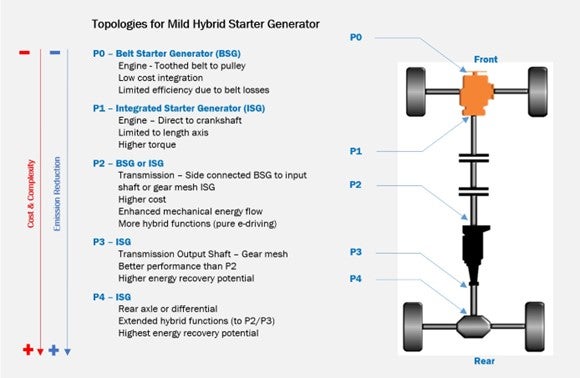
While both BSG and ISG perform similar functions in MHEVs, the key differences lie in their physical placement, connection to the engine, and integration within the vehicle. The BSG is typically externally mounted and connected via a belt drive system, making it suitable for retrofitting existing vehicles. On the other hand, the ISG is compact and more integrated into the engine, thus providing faster response times and higher efficiency. P0 – P4 are the current designated positions, and each provides varying levels of capability and design challenges for the system. Power output, method of coupling to the powertrain and associated functions of the BSG/ISG are not identical for the P0-P4 locations. This gives OEMs the flexibility to integrate ISG to varying extents, at different costs and performance benefits.
During acceleration or when additional power is required, the BSG/ISG can provide an electric boost to the ICE. This electric assistance reduces the load on the engine, improving fuel efficiency and reducing emissions. When the vehicle is in motion, the BSG/ISG operates as a generator. By recovering kinetic energy during deceleration and braking, converting it into electrical energy. Due to the four times higher voltage level than 12 V, a 48V generator can recuperate more kinetic energy, which can be used to power energy demanding systems and recharge the vehicle’s battery.
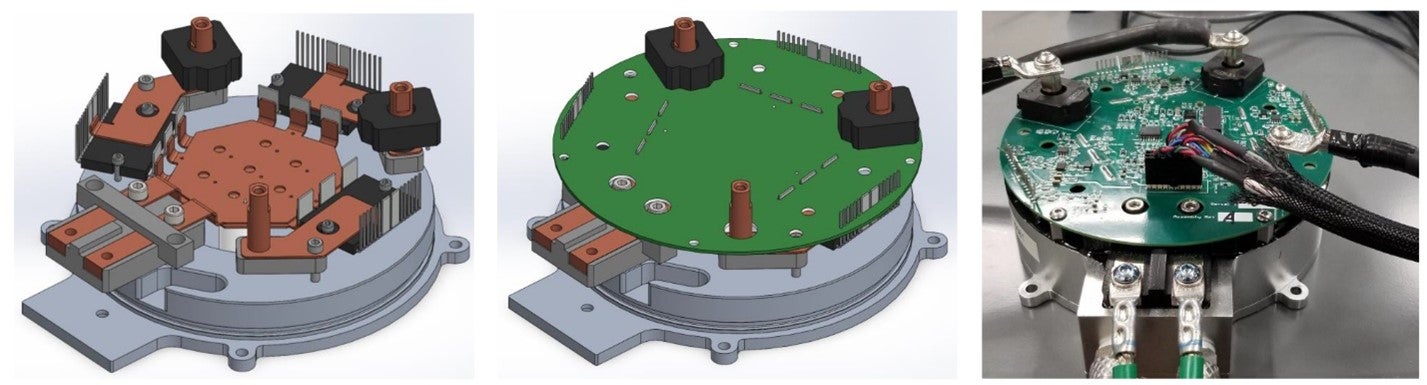
Onsemi released its latest APM21 automotive power modules (APM) to strengthen its existing coverage of APM12, APM17 modules for 48 V systems. The new NXV10V160ST1 (APM21) integrates six 100 V MOSFETs and can handle 3 phases for typical applications like 48 V Inverter, E-compressor and other auxiliaries. NXV08B800DT1 is one of the APM17 modules , designed for 2-channel back-to-back 48 V battery switch.
APM17 modules are mostly configured as dual half-bridges, which can easily be connected on a PCB to form a single half-bridge suitable for twice the phase current. Three modules may be configured to drive a 3−phase motor or 6−phase motor. APMs achieve RDS(on) rating as low as 0.58 mΩ per MOSFET and thermal resistance Junction−to−case, Rth(j-c) 0.19 K/W. onsemi provides components for many 48 V applications including ISG/BSG, 48 V to 12 V DC-DC converter, main or load battery switch (mechanical relay replacement), powering low voltage traction and 48 V auxiliary loads.
The advantages of APM also include:
- Low junction-sink thermal resistance MOSFET in modules.
- Highly integrated and compact design (snubber inside module, temperature sensing) with low stray inductance & better electromagnetic interference (EMI).
- Provides efficient high current handling without the necessity for high current path in PCB.
- Various RDS(on) ratings can match the end user’s current requirements, and a variety of pin−out options to enable different system designs.
- The transfer-molded body with integrated, electrically isolated direct bond copper (DBC) ceramic substrate provides robust reliability and high thermal performance, suitable for bolted or clamped assembly to a heatsink.
- Power leads are suitable for welding to the assembly’s bus bar structure for low inductance connection to the DC link input filter.
While 48 V systems have been utilized in MHEVs for some time now, the replacement of the traditional 12 V system is a significant step forward for the automotive industry. As more automakers recognize the multiple benefits of the 48 V system, we expect them to be looking for solutions to upgrade the soon-to-be-come legacy systems.
Since 48 V systems are integrated next to ICE and mechanically stressed parts, they must be as compact and robust as possible. Heat dissipation is crucial when it comes to any power electronics located next to ICE. APMs from onsemi have been designed with these necessities in mind and integrated into one robust package that is ready for automotive applications.
Additional resources for your design considerations: